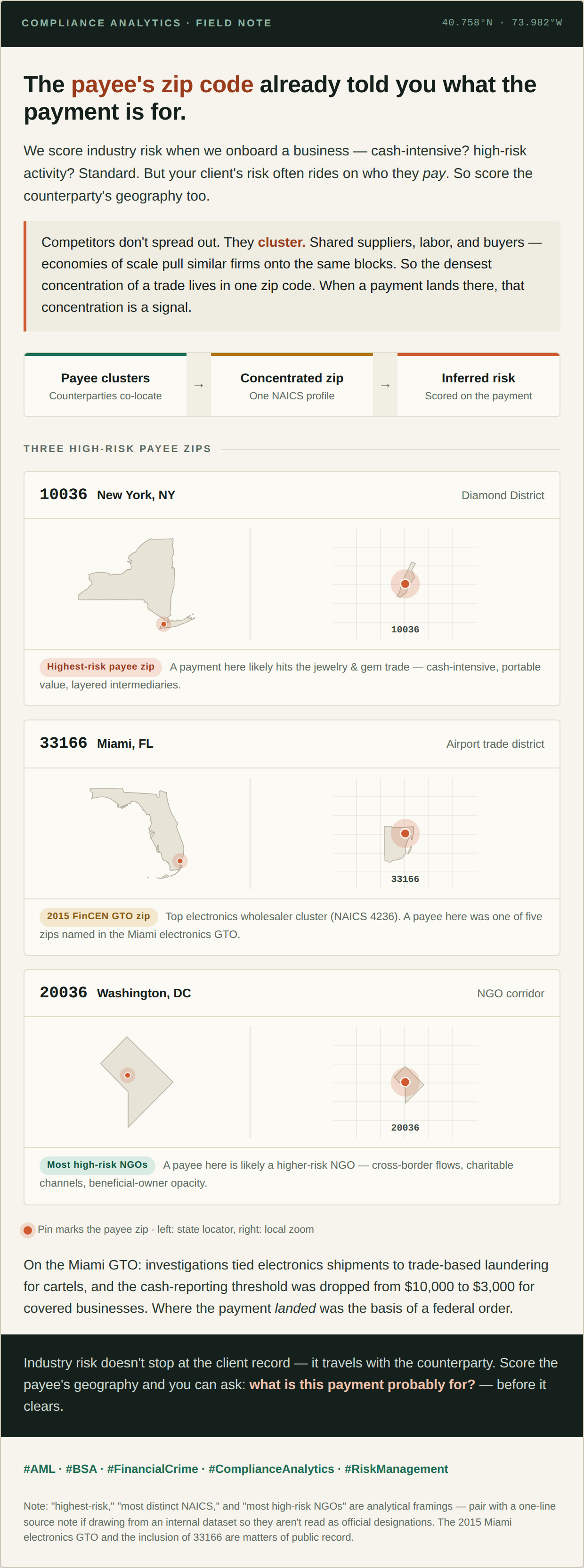
Score the payee's geography and you can ask: what is this payment probably for? — before it clears.
It's standard practice to include an industry risk factor when onboarding a new business client — does the client engage in high-risk activities, are they cash-intensive, and so on. But a client's exposure often rides on the counterparty. So why not calculate industry risk at a geographic level, applied to the payee, to infer what a payment may be related to?
Why similar businesses cluster
It seems counterintuitive: you'd expect competitors to spread out and avoid each other. They don't. Similar businesses cluster in the same geographies because proximity creates economies of scale — shared suppliers, a common specialized labor pool, the same buyers walking the same corridor, and the reputational pull of a recognized trade district.
The result is that the highest concentration of a given industry often sits inside a single zip code. And that concentration is data. When a payee operates in a zip dominated by one industry profile, you can infer — when appropriate — what a payment is likely related to, and apply an industry risk factor at the geographic level.
Three high-risk payee zips
Three examples make the idea concrete — three different typologies, three different reasons the geography matters.
10036 — New York's Diamond District
The highest-risk zip in this framing. The blocks around 47th Street concentrate the jewelry and gem trade: cash-intensive, extremely portable value, and layered intermediaries. A payment landing here tells you a great deal before you read the memo line — the industry profile is, quite literally, the geography.
33166 — Miami, near the airport
This zip carries the most distinct NAICS codes of the three examples and the highest concentration of electronics wholesalers (NAICS 4236). It is also history: in 2015, FinCEN issued a Geographic Targeting Order to roughly 700 Miami-area electronics exporters — 33166 among five named zip codes — after investigations connected electronics shipments to trade-based money laundering on behalf of drug cartels. The order lowered the cash-reporting threshold from $10,000 to $3,000 for covered businesses. Where the payment landed was the basis of a federal order.
20036 — Washington, DC
A different typology entirely — the largest concentration of higher-risk NGOs. Cross-border flows, charitable channels, and beneficial-ownership opacity make this corridor worth scrutiny, even absent the cash dynamics of the other two.
From client record to inference layer
Industry risk doesn't have to stop at the client's own profile — it travels with the counterparty. Encoded at the geographic level and applied to the payee, it becomes an inference layer that lets you ask the most useful question in monitoring: what is this payment probably for? — before the transaction clears.
Note: "highest-risk," "most distinct NAICS," and "most high-risk NGOs" are analytical framings — pair with a source note if drawing from an internal dataset so they aren't read as official designations. The 2015 Miami electronics GTO and the inclusion of 33166 are matters of public record.